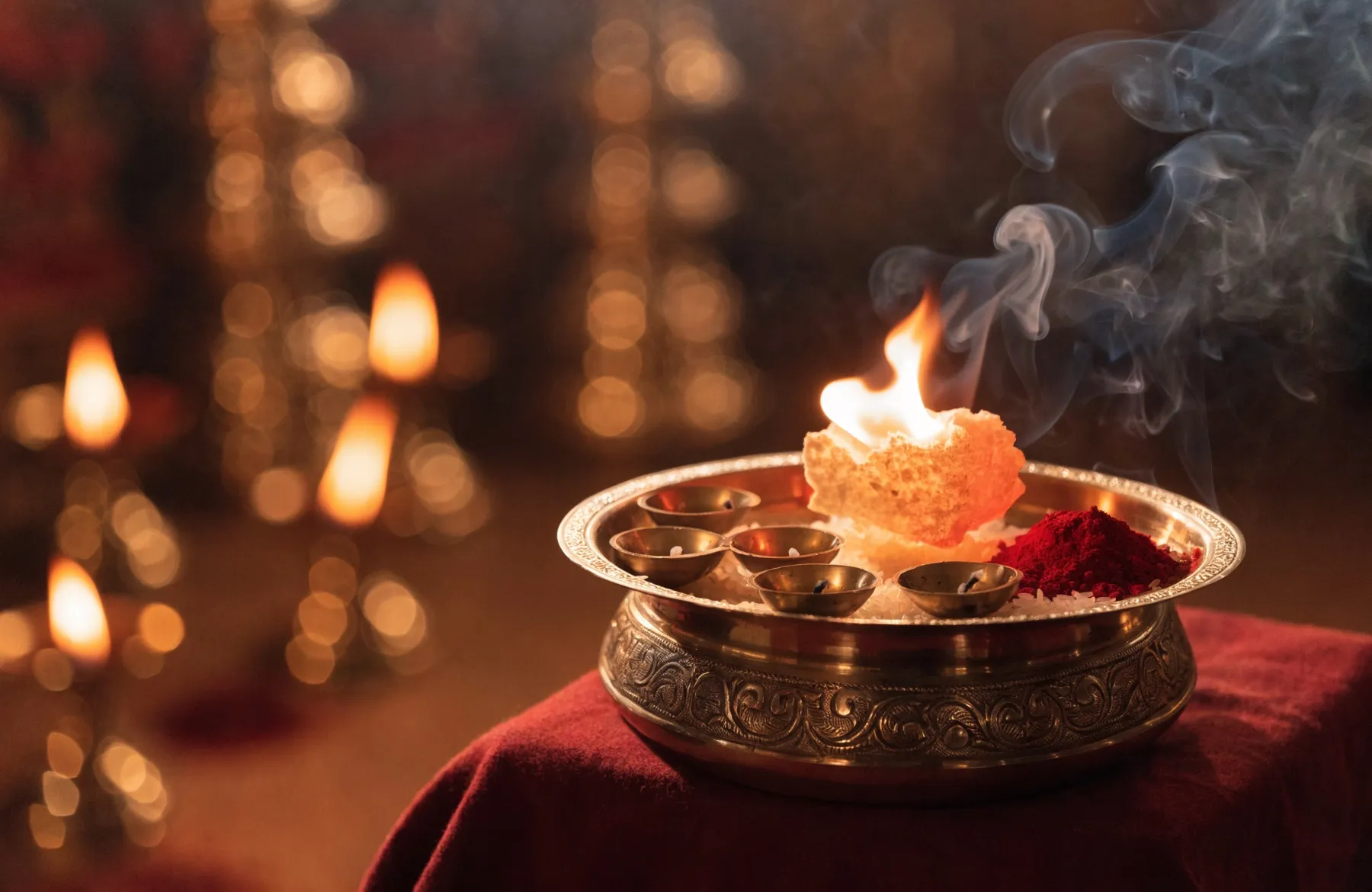
What is aarti?
Aarti is the offering of light: a lamp of burning ghee or camphor is circled before the deity while a hymn is sung. It is Hinduism's most universal act of worship, performed daily in temples and homes. At our mandir aarti is offered every day at 11am and 7pm.
If you visit our mandir at 11am or 7pm you will walk into the middle of it: bells, a drum, a small fire moving in slow circles, and a room full of people singing something they clearly know by heart.
This is aarti, and it is the most characteristic thing Hindus do.
What happens
A lamp — usually ghee-fed wicks or camphor — is lit and circled clockwise before the deity, while a hymn is sung and bells are rung. It is offered to each murti in turn.
Then the lamp is brought out to the congregation. As it passes, people cup their hands briefly over the flame and touch them to their eyes and forehead.
That gesture is the part visitors most often ask about. It is simple: the light has been offered to God and has become blessed. You are taking a little of it for yourself — for your sight, and for your mind.
You are welcome to do it. You are equally welcome to smile and let it pass.
What it means
Fire is the oldest offering in the Hindu tradition — older than temples, older than murtis, running straight back to the Vedas. Fire is what carries an offering from here to there.
In aarti, what is being offered is light itself — and, in the giving, the self. The lamp is circled because the divine has no single side to face. The flame is small and the darkness is large, and that is precisely the point.
There is a practical dimension too. Ghee lamps are what people had. A hymn is something everyone can join. Aarti is worship anybody can perform, in a palace or a kitchen, which is why it has outlasted everything else.
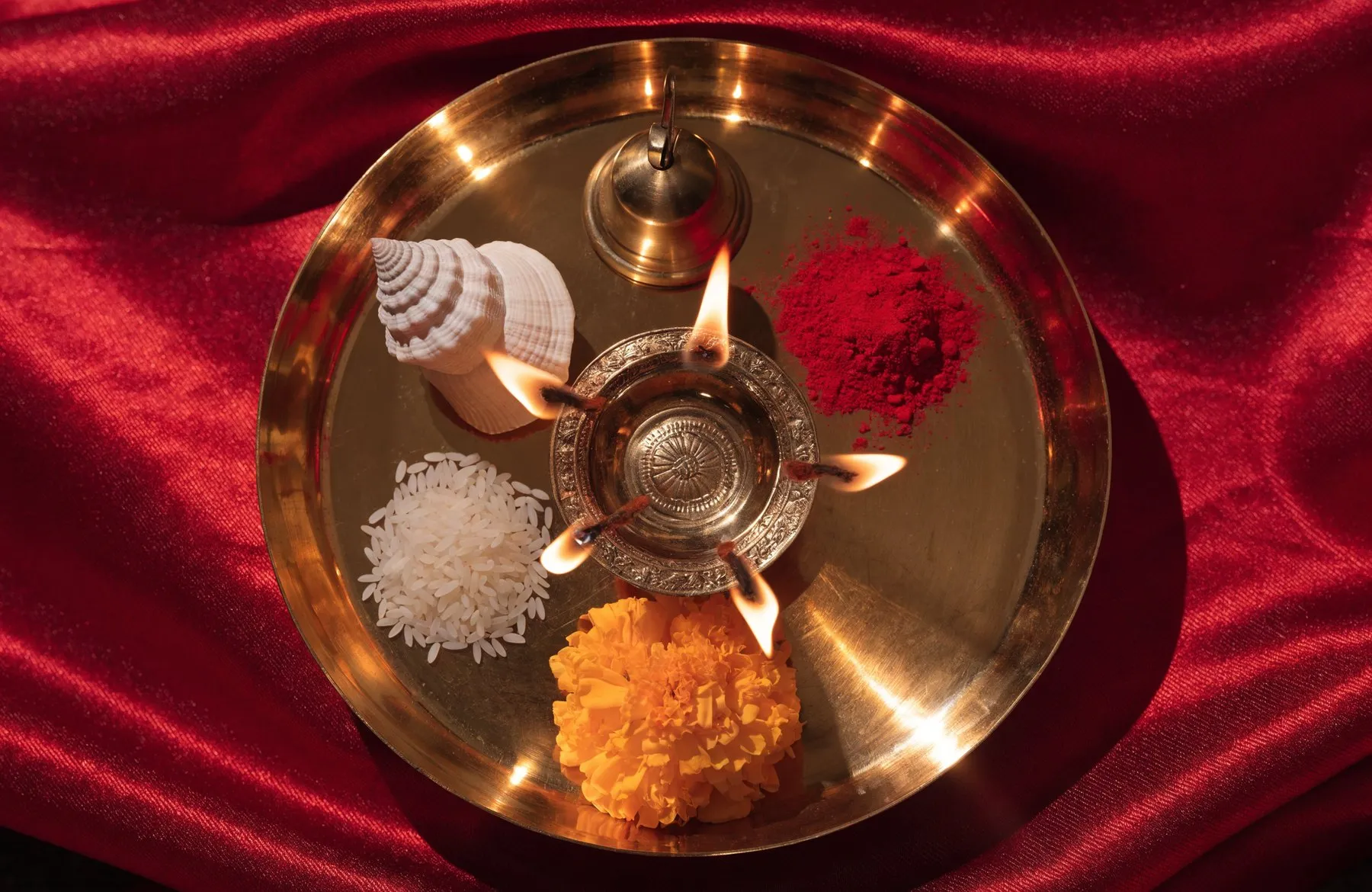
The thali, prepared. What is circled before Maa is what comes back to you.
Aarti at our mandir
Every day at 11am and 7pm. Both are broadcast live on our Facebook page for devotees who cannot be here.
Our morning aarti is Pratahkaal Ki Aarti — Jag Janani Jai Jai, “Victory to the Mother of the World”. Our evening aarti is the Punjabi Ratri Ki Aarti — mandir vich aarti jai maa, sung as the day closes.
We publish both texts in full — you can read them here. If you would like to follow along or learn them, they are yours.
Can I join?
Yes. Stand with everyone. You don’t need to know the words; plenty of people who come every week are still learning them. Clap along if it feels natural.
Aarti lasts around twenty minutes to half an hour, and afterwards there is prasad. On Tuesdays the 7pm aarti sits inside our Kirtan & Langar (6–8pm) — so the singing comes before it, and a free meal follows.
Families sponsor a day’s aarti for a birthday, an anniversary, or in memory of someone they’ve lost. If you’d like to do that, talk to us.
Come to aarti. 11am or 7pm, any day, at our mandir in Willenhall. You’ll be welcome, and someone will show you what to do. Plan your visit.