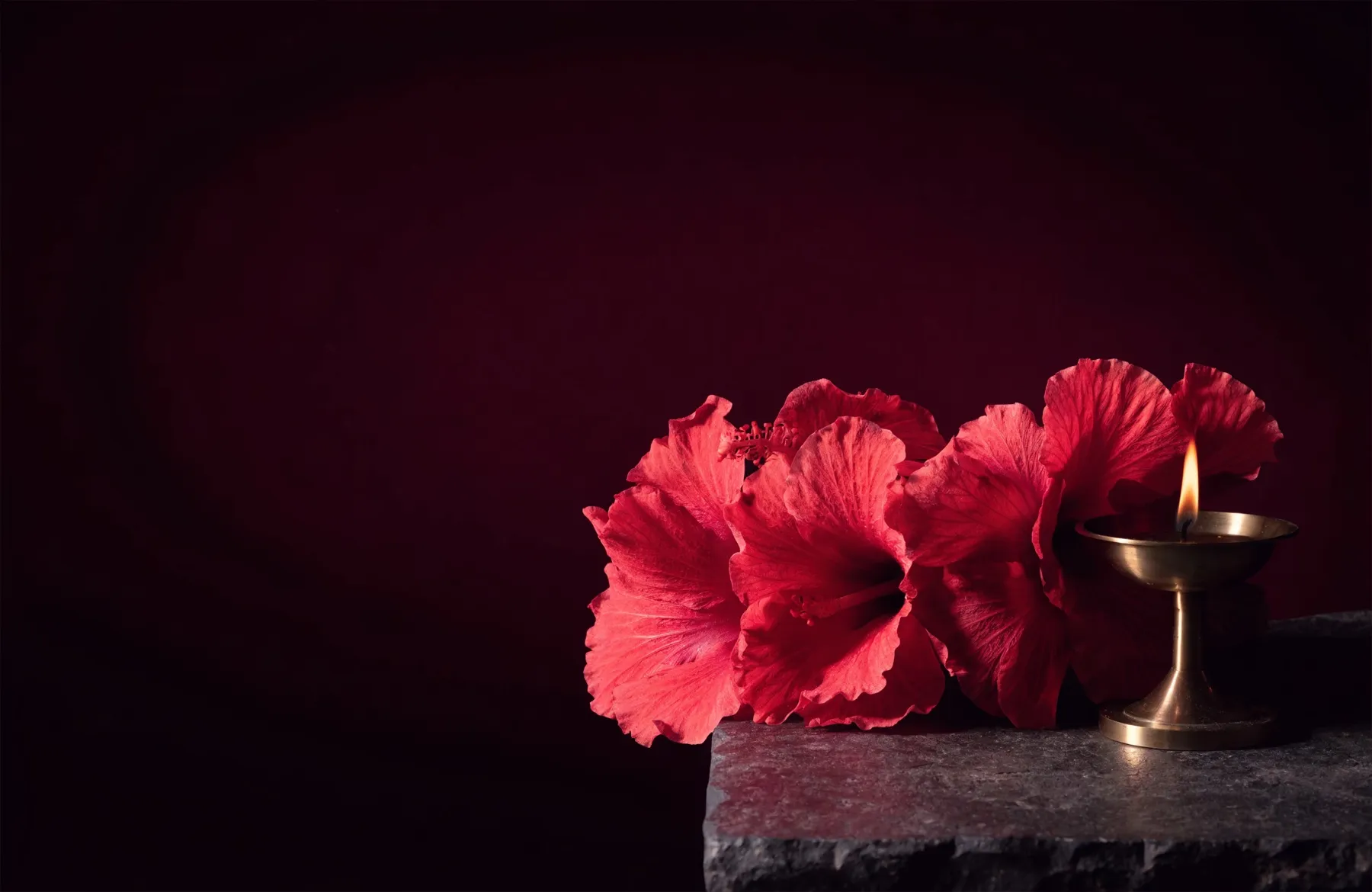
Who is Maa Kali?
Maa Kali is the Hindu Divine Mother in her most powerful form — the goddess who destroys evil, ego and fear. Though her imagery looks fearsome to newcomers, to her devotees Kali is above all a mother: fierce in protecting her children, and infinitely tender towards them.
Of all the forms of God in Hinduism, none is more misunderstood outside the tradition than Kali. A dark goddess with a garland of severed heads, a lolling tongue, a sword in her hand and her foot upon her own husband — to an outsider it can look terrifying.
To those who worship her, it is the opposite. Kali is Maa — Mother. Our devotees do not come to this mandir in fear. They come as children come to their mother: to be comforted, to be protected, to be told the truth.
This page explains who Kali really is.
The Mother in her fiercest form
Hinduism understands the one Divine reality as appearing in countless forms. Shakti is the name for God’s active power — the living energy that creates, sustains and dissolves the universe. That power is understood as feminine: the Goddess, Devi, the Mother of all.
Kali is Shakti at her most concentrated. Where Lakshmi blesses with abundance and Saraswati with wisdom, Kali does the work that only a mother can do: she destroys what is destroying you.
Her name comes from the Sanskrit kāla, meaning both time and black. Kali is time itself — that which eventually consumes everything that is born. To fear her is simply to fear the truth. To love her is to be free of it.
What her imagery actually means
Every element of Kali’s form is a teaching, not a threat:
- Her dark colour. Black absorbs every other colour and gives none back. Kali is the ground of reality into which all forms dissolve — beyond name, beyond shape, beyond description.
- Her nakedness. She is clothed in nothing but space (digambari — “sky-clad”). Truth has nothing to hide and nothing to add.
- Her garland of severed heads. Traditionally fifty — the letters of the Sanskrit alphabet. Kali wears human language itself as an ornament: she is beyond what can be said about her. To her devotees they also represent the ego she severs, again and again, out of love.
- Her sword. Not for punishment — for cutting. What it cuts is ignorance, and the false idea that we are separate from God.
- Her skirt of arms. Arms are the instruments of action, of karma. She wears our actions lightly.
- Her four hands. Two hold the sword and a severed head. The other two are raised in abhaya mudra (“do not fear”) and varada mudra (“I grant”). This is the whole of Kali in one image: the hands that destroy and the hands that reassure belong to the same Mother.
Her extended tongue carries several meanings — we explain them here — and her standing upon Shiva is the deepest teaching of all, which we explain here.
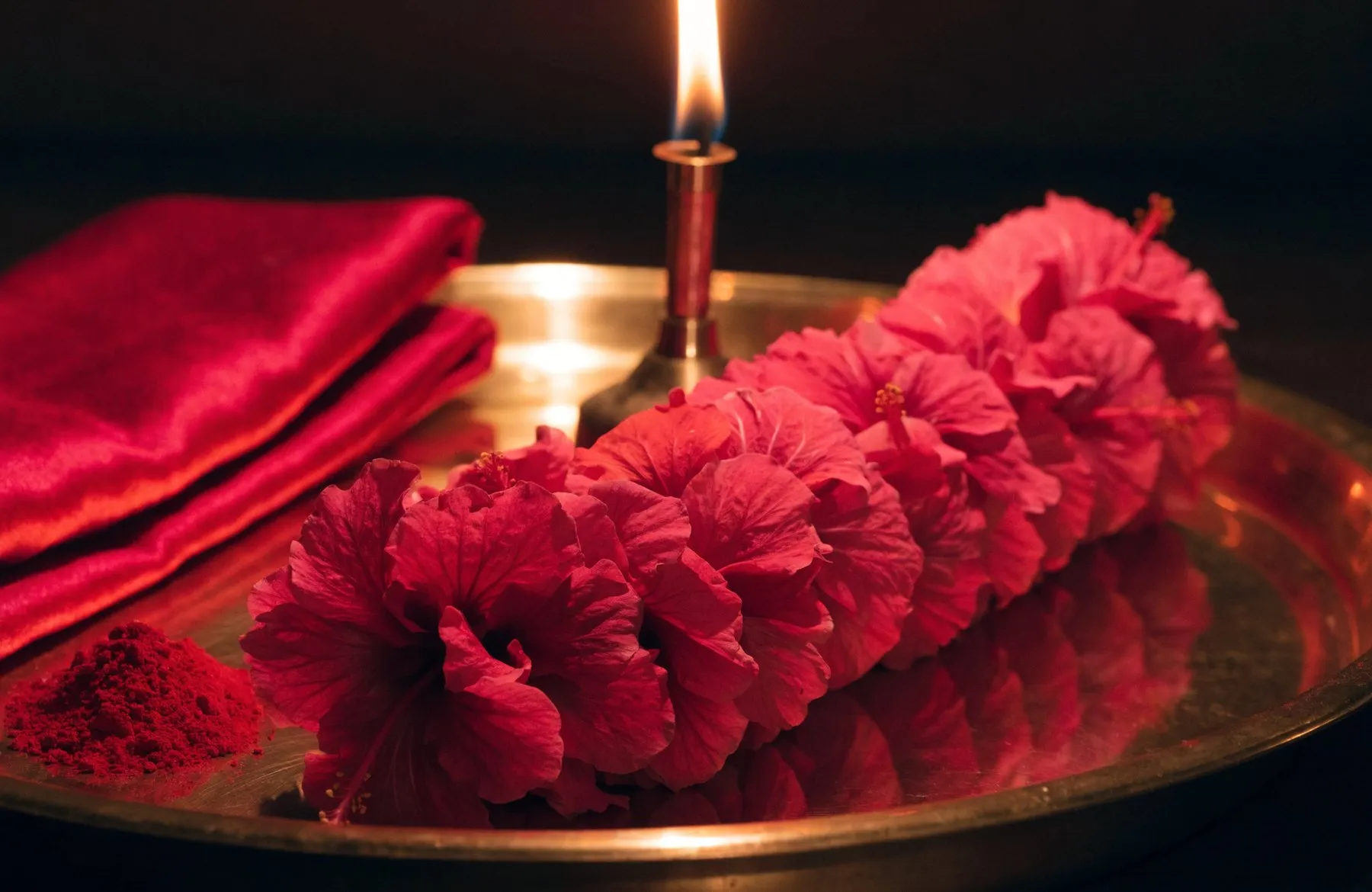
Red hibiscus, her flower, brought to her by devotees every day of the year.
Where Kali comes from in scripture
Kali’s great scriptural appearance is in the Devi Mahatmya (also called the Durga Saptashati or Chandi Path) — seven hundred verses forming part of the Markandeya Purana, composed around the 5th–6th century CE. It is the foundational text that declares the Goddess to be supreme in her own right, not merely a consort.
In it, the goddess Durga battles the demons Shumbha and Nishumbha. When her fury reaches its height, Kali springs forth from Durga’s brow — black, gaunt, terrible, laughing. She devours the demon Raktabija, whose every drop of spilled blood created a new demon; Kali drinks the blood before it can fall, and the battle is won.
The lesson is not gratuitous. Some evils cannot be reasoned with. Some things must simply be ended, and it is the Mother who ends them.
Kali is also counted as the first of the Mahavidyas, the ten great wisdom-goddesses — and in the Shakta tradition to which this mandir belongs, she is understood as Adi Parashakti: the primordial power, ultimate reality itself.
Kali is one Devi among many — and all of them are one
Newcomers often ask whether Kali, Durga, Parvati and Lakshmi are different goddesses. The Hindu answer is subtle: they are distinct forms, and they are one Mother.
Durga is the Devi as the invincible warrior riding her lion; Parvati is the Devi as the gentle consort of Shiva; Kali is the Devi as the destroyer of what must be destroyed. In the Devi Mahatmya, Kali emerges from Durga — one Mother showing a different face when a different face is needed. More on Durga and Kali here.
How Kali is worshipped
At our mandir Maa Kali receives aarti twice daily, at 11am and 7pm — the offering of light, with song. Devotees bring flowers, fruit, coconut and a red chunni for the Mother.
Her greatest night is Kali Puja, which falls on the new-moon night of Diwali — while much of the Hindu world lights lamps for Lakshmi, Kali’s devotees keep vigil for the Mother in the dark. More about Kali Puja. She is also worshipped through the nine nights of Navratri, and honoured at every jagran — the all-night vigil of her praise.
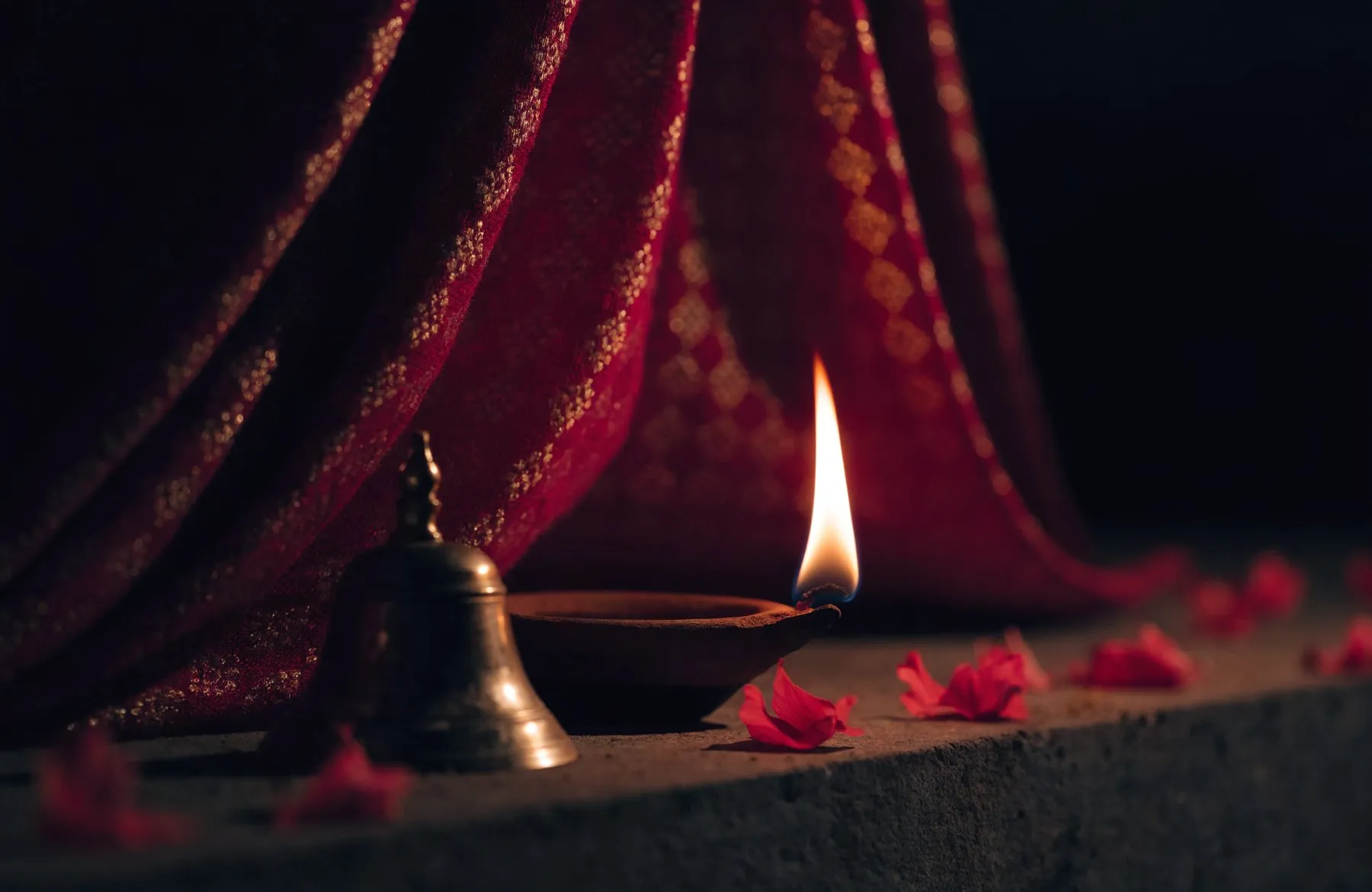
She is worshipped most of all at night — and by devotees who are not frightened of her at all.
A word to those who find her frightening
If Kali’s image unsettles you, you are not doing anything wrong — you are seeing exactly what she wants you to see. She is the form God takes when comfortable illusions have stopped working.
The devotees who love her most are often those who have been through the hardest things. They will tell you that when everything you were holding onto has been stripped away, what remains is a Mother who never left.
Her hand is raised. It says: do not be afraid.
Visiting. Maa Kali presides over our mandir in Willenhall, West Midlands, alongside Maa Bhameshwari. Everyone is welcome at darshan — of any faith, or none. Plan your visit.