Why does Kali stand on Shiva?
Kali stands on Shiva because she is Shakti — the active power of the universe — and he is pure consciousness, still and unmoving. The image teaches that consciousness without power cannot act, and power without consciousness has nothing to move upon. They are two aspects of one reality, not two rivals.
It is the image that stops every first-time visitor: the dark goddess, mid-stride, one foot planted on the chest of a pale figure lying beneath her — her own husband, Lord Shiva.
Newcomers sometimes read it as violence, or as a wife humiliating her husband. It is neither. It is one of the most profound things Hinduism has ever put into a picture.
The teaching: Shakti and Shiva
In the Shakta tradition — the worship of God as Mother, which is our tradition — reality has two inseparable aspects:
- Shiva is pure consciousness. Awareness itself. Perfect, infinite, and utterly still. Consciousness does not do anything; it simply knows.
- Shakti is power. Energy, movement, creation. She is what acts.
Everything that exists — this world, your body, this moment — is Shakti in motion. But she moves upon the ground of consciousness. Neither can be what it is without the other.
So when Kali stands upon Shiva, she is not defeating him. She is standing on the ground of consciousness in order to act. He is the still point; she is everything that moves.
There is a saying in the tradition: Shiva without Shakti is shava — a corpse. It is a play on words: remove the i (Shakti’s own vital sound) from śiva and you are left with śava, “corpse”. Pure consciousness without power cannot lift a finger.
The Saundarya Lahari, the great hymn to the Goddess, opens with exactly this thought: united with Shakti, Shiva has the power to create — otherwise, it says, he “cannot even stir.”
(The “shava” line is a much-loved traditional aphorism rather than a verbatim scriptural verse, and is often mistakenly quoted as the Saundarya Lahari’s opening. The meaning, though, is precisely what that verse teaches.)
The story: the Mother who stopped
Philosophy is one thing; the story devotees actually tell is this.
In the great battle, Kali destroys the demon Raktabija — but her fury does not stop with him. Victorious, drunk on the intensity of her own power, she begins to dance, and her dance grows so wild that the earth itself starts to shake. The universe she was defending is now in danger of being destroyed by its own defender.
The gods panic. They turn to Shiva.
And Shiva does not fight her. He does not command her. He simply walks onto the battlefield and lies down among the corpses, directly in her path.
Kali dances on — and her foot comes down on her own husband. In that instant she recognises him. Her tongue shoots out; the dance stops; her fury dissolves into a mother’s tenderness. The world is saved — not by opposing her power, but by her own recognition.
Look again at any Kali murti and you will see it: her foot is on his chest, but her hands are raised — do not fear, I grant. The rage has already passed. What you are seeing is the moment of recognition itself.
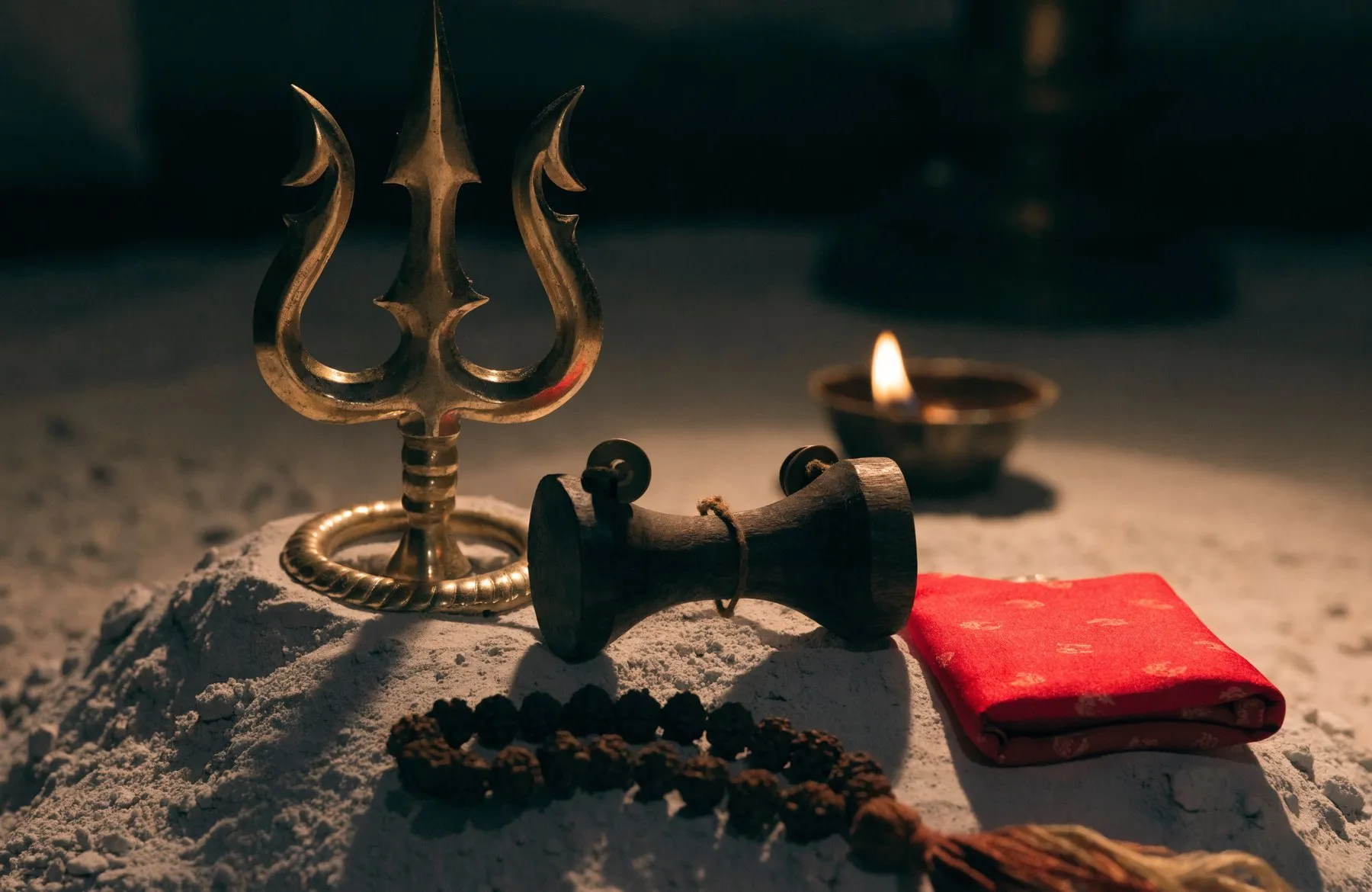
His emblems and her cloth, together. The image is about the pair — not about a victory.
What devotees take from it
Two things, mostly.
That the fiercest power in the universe answers to love. Nothing stopped Kali — not armies, not gods. Only recognising the one she loved beneath her foot.
That there is no shame in being the still one. Shiva does not lose by lying down. He is the ground that lets her act at all. In the Shakta understanding, that is not defeat but the deepest kind of support.
A note on the images
Kali standing on a supine Shiva — with her right foot forward — is the form called Dakshinakali, the benevolent, boon-giving Kali. It is the form enshrined at our mandir, and the form most widely worshipped in Bengal, Assam and across the Punjabi Devi tradition.
Regional practice varies. Kali is not depicted identically everywhere: some traditions show her seated, some red-skinned rather than black, some with the left foot forward (the fiercer Vama form). What never varies is the meaning of her feet upon Shiva: the living power of the universe, moving upon the ground of pure awareness.
See her for yourself. Maa Kali stands in her Dakshinakali form at our mandir in Willenhall. Plan your visit — or read more about who Maa Kali is.