What is Hinduism?
Hinduism is the world's oldest living religious tradition, followed by around a billion people. It is not a single church with a single founder or creed — it is a vast family of traditions sharing core ideas: one ultimate reality appearing in many forms, the law of karma, the duty of dharma, and liberation (moksha) as life's final goal.
Hinduism is difficult to summarise, and honest teachers say so at the start.
It has no founder. No single book. No pope, no central authority, and no agreed date of birth. It is less a religion in the Western sense than a civilisation’s worth of religious tradition, grown over several thousand years, in which a great many different things are believed — and that is not considered a problem.
What follows is a genuine introduction, not a simplification.
What Hindus share
Beneath the variety, most Hindu traditions hold:
- One ultimate reality. Called Brahman — infinite, formless, beyond description, present in everything.
- Many forms of the divine. Because an infinite formless reality is hard to love, God takes forms — Kali, Shiva, Vishnu, Ganesh, Lakshmi. Not competing gods; one divine reality in many forms.
- The atman. The self within you is not separate from that reality. “Thou art That.”
- Karma. Every action has consequence. Not divine punishment — more like a moral physics.
- Dharma. Right action; your duty, given who and where you are.
- Samsara and moksha. The soul is reborn across many lives; the goal is not heaven but moksha — release from the cycle, and the end of the illusion of separateness.
One God or many?
This is the question every visitor asks, so let’s answer it directly.
Hindus generally say one. The Rig Veda — the oldest scripture — puts it plainly: “Truth is one; the wise call it by many names.”
What looks like polytheism is closer to this: if the divine is infinite, then any form it takes is a doorway, not a boundary. A devotee of Kali is not worshipping one god from a catalogue. They are worshipping the Absolute, in the form through which the Absolute has chosen to be loved by them.
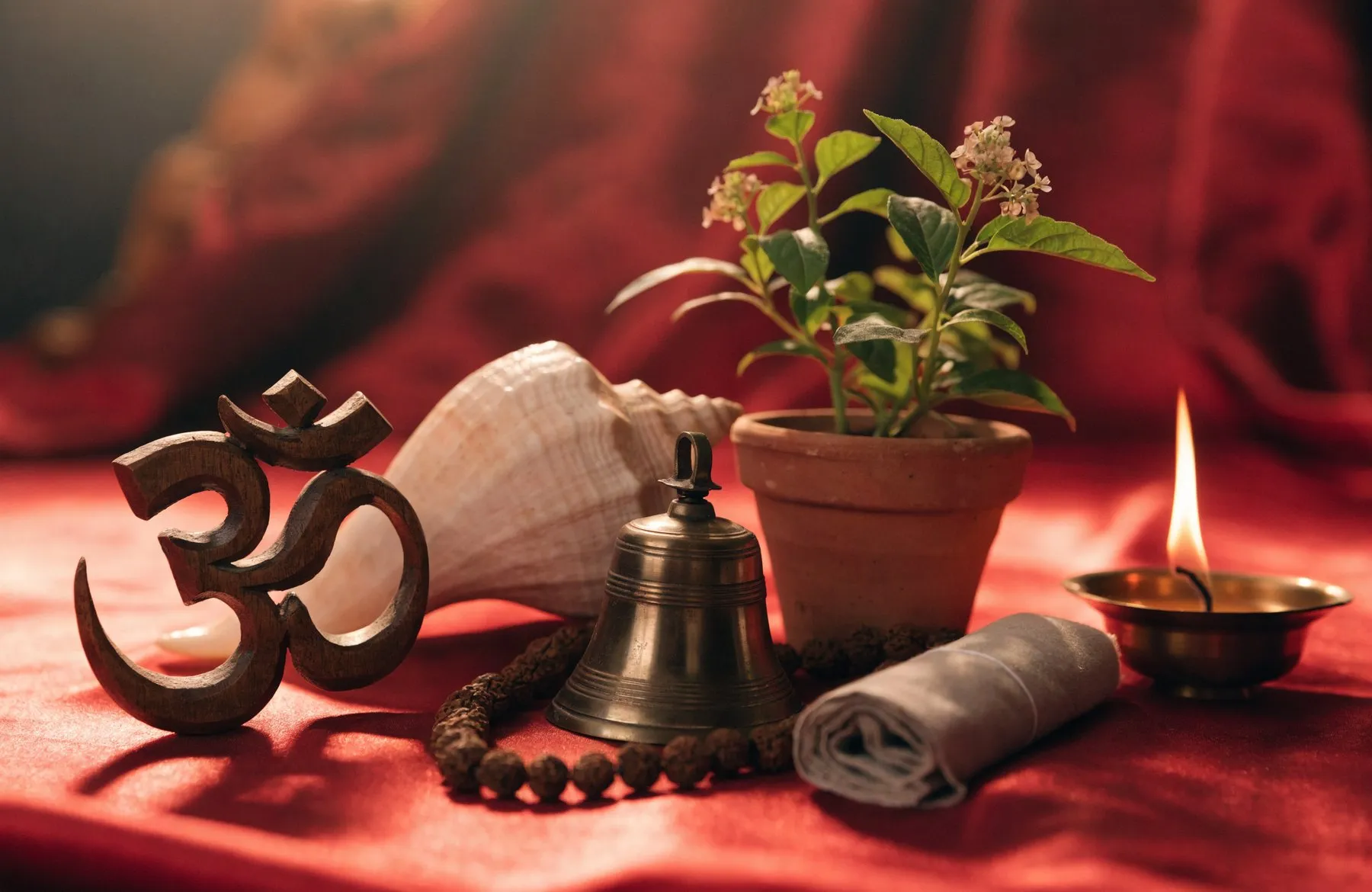
No founder, no single book, no one authority. A tradition of many things held together.
The main traditions
Hinduism has four great streams, distinguished mainly by which form of the divine they hold supreme:
- Shaktism — worships God as Mother, the Devi, as ultimate reality. This is our tradition. Kali, Durga, Lakshmi, Saraswati.
- Shaivism — worships Shiva as supreme.
- Vaishnavism — worships Vishnu and his avatars, especially Krishna and Rama.
- Smartism — worships several forms as equal expressions of the one Brahman.
These are not sects at war. Most Hindu families move between them comfortably. Our own mandir has Maa Kali at its heart and shrines to Shiv Parivar, Radha–Krishna, Ganesh Ji and Hanuman Ji — which no Hindu finds contradictory.
The scriptures
There is no single Bible. There is a library:
- The Vedas — the oldest, revealed (shruti, “heard”).
- The Upanishads — the philosophical heart.
- The Bhagavad Gita — Krishna’s teaching to Arjuna; the most widely read.
- The Ramayana and Mahabharata — the great epics.
- The Puranas — including the Devi Mahatmya, the foundational text of Goddess worship.
What Hindus actually do
Belief matters less in Hinduism than practice. Day to day, it looks like:
- Darshan — coming before the deity to see and be seen.
- Puja — worship: offering light, flowers, food.
- Festivals — Diwali, Navratri, Holi, Janmashtami, and dozens more.
- Seva — selfless service, expressed most directly as feeding people.
- Sanskars — the ceremonies marking a life: naming, first food, marriage, the final rites.
Hinduism in Britain
Around a million Hindus live in the UK, with a large and long-established community across the West Midlands. British Hindu families keep the tradition in ways that would be recognisable in Punjab or Gujarat, adapted to a country where Diwali falls on a work night and the festival dates themselves need recalculating for British time.
Our mandir has stood in Willenhall since 2016. Everyone is welcome in it — of any faith, or none.
If you’d like to understand it properly
Come and stand in a mandir for twenty minutes. Hinduism is not primarily a set of propositions to be agreed with; it is something done, in a room, with other people, in front of a form of God.
Reading about it will only get you so far. That’s not a criticism of reading — it’s the nature of the thing.
Visiting or studying Hinduism? School and community groups are warmly welcome at our mandir in Willenhall — get in touch, or plan your visit.