Beside Shani Dev's shrine
The Navagraha नवग्रह
The nine celestial powers — the sun, the moon, five planets and the two lunar nodes, who carry karma into a life.
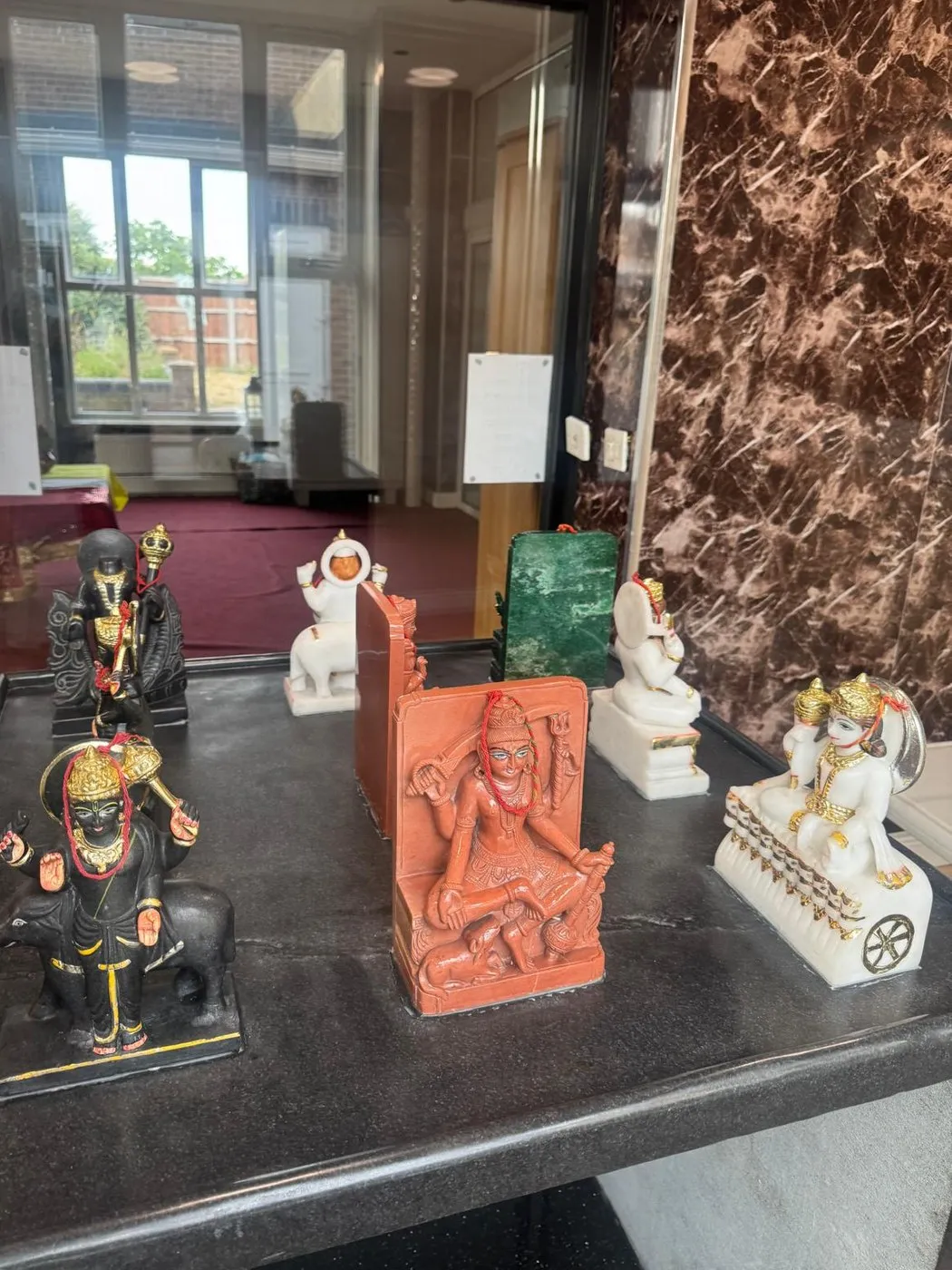
Beside Shani Dev stand the Navagraha — the nine celestial powers of Hindu tradition. Not nine gods of nine places, but nine forces said to carry the fruit of a person’s own actions into their life, in their own time and their own order.
Who they are
Nine, and each with its own nature, colour, grain, metal and day:
- Surya — the sun. The soul, the father, authority and vitality. Sunday. — enshrined separately here
- Chandra — the moon. The mind, the mother, feeling and memory. Monday.
- Mangal — Mars. Courage, energy, land and conflict. Tuesday.
- Budh — Mercury. Intellect, speech, commerce and wit. Wednesday.
- Guru (Brihaspati) — Jupiter. Wisdom, teachers, expansion and grace. Thursday.
- Shukra — Venus. Love, beauty, art and comfort. Friday.
- Shani — Saturn. Discipline, labour, and the exact return of what is owed. Saturday. — enshrined separately here
- Rahu — the north lunar node. Longing, obsession, the shadow that swallows the sun.
- Ketu — the south lunar node. Detachment, loss, and the strange freedom that follows it.
Seven of them name the days of the week — as they do in English, through a different route: Sunday and Monday for sun and moon, Saturday for Saturn.
Rahu and Ketu are not planets at all. They are the two points where the moon’s path crosses the sun’s — the places where eclipses happen. Tradition tells of a demon who stole a sip of the nectar of immortality and was beheaded for it, so that the head and the body both live on, forever chasing the sun and moon that betrayed him. It is a story about appetite, and about what remains when it is cut away.
Reading the shrine
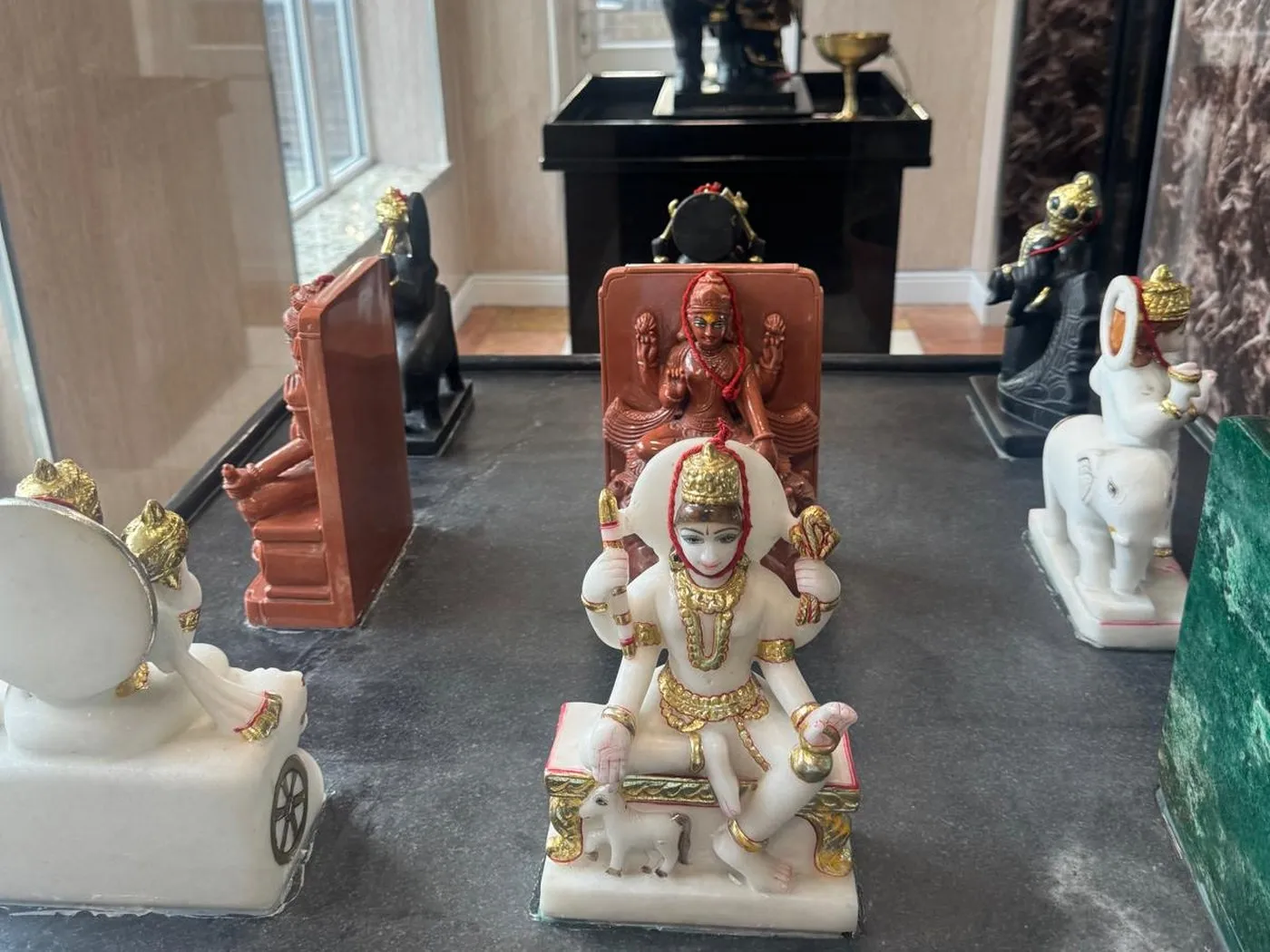
The Navagraha are traditionally set in a three-by-three square, with Surya at the centre and the other eight around him, each facing a different direction so that no graha meets another’s gaze. Their looks are held to be powerful and not always friendly to one another; the arrangement keeps them at peace.
Devotees walk clockwise around them, often nine times, offering to each in turn — and the offerings differ, graha by graha: a colour, a grain, an oil, a flower. It is one of the most quietly absorbing forms of worship in a mandir, and one of the oldest.
The Navagraha at our mandir
Our Navagraha shrine sits beside Shani Dev, who is himself one of the nine and by far the most visited. Devotees come especially on Saturdays, and on Shani Amavasya when the new moon falls on a Saturday.
Our priest performs Navgraha Shanti havan — the fire ceremony to pacify the nine — traditionally before a wedding, at the opening of a business, or in a season when things have repeatedly gone wrong. It is one of the most requested ceremonies at the mandir.
A word on what this is and is not. The Navagraha are worshipped, first and last. Hindu tradition also reads them through Jyotisha, and if you would like guidance on an auspicious timing or a birth chart, our Pandit Ji gives that privately and without drama. But you do not need to know a thing about your chart to stand here. Come, walk round, and offer what you have.
Questions people ask
Is the Navagraha astrology, or is it religion?
Both, and the distinction matters less in Hindu tradition than it might seem. The Navagraha are worshipped as divine powers in their own right — they receive puja, offerings and havan like any deity. They are also the nine bodies of Jyotisha, the traditional Indian system of astronomy and astrology. At the mandir they are treated first and foremost as objects of worship. If you want traditional guidance on timings or a birth chart, our Pandit Ji offers that separately and privately.
Who are the nine?
Surya (the sun), Chandra (the moon), Mangal (Mars), Budh (Mercury), Guru or Brihaspati (Jupiter), Shukra (Venus), Shani (Saturn), and the two shadow-grahas Rahu and Ketu — the north and south lunar nodes, which are points rather than bodies and are said to cause eclipses. Seven of them give their names to the days of the week, in Hindu tradition as in English.
Why are the Navagraha arranged in a square, all facing different ways?
The traditional arrangement places Surya at the centre with the other eight around him in a three-by-three grid, each facing a different direction so that no graha looks directly at another. The reason given is that their gazes are powerful and not always compatible — the layout keeps the peace between them. It is one of the most distinctive sights in a mandir.
Why do people walk around the Navagraha shrine?
Devotees traditionally circle the shrine clockwise — often nine times, one for each graha — offering to each in turn. If you are unsure what to do, simply walk round quietly and respectfully; a sevadar will gladly show you. There is no wrong way to stand before God.
What is a Navgraha Shanti havan?
It is a fire ceremony performed to pacify the nine planets, traditionally held before a wedding, at the start of a new venture, or during a stretch of repeated difficulty. Our priest performs it at the mandir — see our pooja services, or call to arrange it.
Go deeper
One God, or many? Understanding Hindu deities
Are Hindus polytheistic? The honest answer to the question every visitor asks — and why the question itself is shaped by the wrong assumptions.
Read →What is darshan?
Darshan is the heart of Hindu worship — and it isn't quite what Western visitors expect. Not a service you attend, but a seeing that goes both ways.
Read →What is Hinduism?
A clear introduction to Hinduism for newcomers — one God or many, what Hindus actually believe, the scriptures, and the ideas of karma, dharma and moksha.
Read →